Written By: Caitlyn Meyers, Catalyst Partners
In today’s real estate market, capital and green building practices are increasingly intertwined. The availability and cost of capital depend on how well projects address climate risk, energy performance, and social impact. According to Climate risk and loan pricing: the moderating role of trilemma policy choices published in July 2025, there is a robust positive association between climate risk indicators and loan prices. Understanding this intersection is becoming a key differentiator and a valuable opportunity.
At the same time, financial institutions are setting sector-specific targets for reducing real estate emissions, directly influencing how and where money flows. According to a 2025 European Central Bank analysis of its Bank Lending Survey, euro-area banks are explicitly tilting loan pricing based on climate performance. 20% of banks expect to ease credit standards for “green” firms, while 35% expect to tighten standards for highly polluting firms. For project managers, that means that sustainability is no longer a “nice-to-have”, it’s a financial advantage.
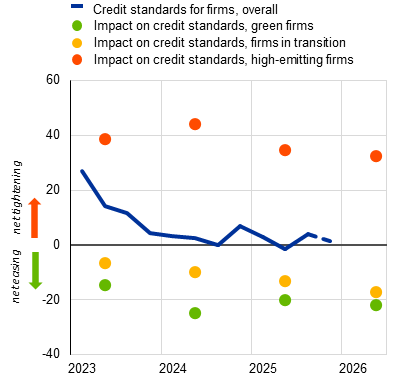
Impact on Credit Standards from Loans to Firms
Source: ECB (BLS).
Traditionally, finance practitioners and green building experts spoke different languages. One focused on balance sheets, the other on building systems. Today, these conversations are converging around sustainable finance instruments. These are tools that can increase access to capital and reduce its cost for efficient resilient projects. Sustainability certifications such as LEED, WELL, BREEAM, or ENERGY STAR now play a direct role in unlocking capital and shaping investment strategy.
There is no single way to finance a green building, but several mechanisms are gaining traction across the market. Here is how they break down:
- Equity Investments
Equity investors take ownership stakes in projects or companies, betting on future value growth. For green projects, this often means investing through green building indices, exchange traded funds (ETFs), and real estate investment trusts (REITs). These instruments offer scalable, transparent ways to align capital with sustainability outcomes.
- Fixed Income Investments
Lenders provide funds with defined repayment terms, often through green loans, sustainability-linked bonds, and green mortgages. Each of these can help project teams secure lower borrowing costs or better terms when sustainability targets are integrated into design and operations.
- Project-Specific Financing
At the asset level, several structures provide flexible, performance-based funding:
- Property Assessed Clean Energy (PACE) financing allows property owners to fund efficiency upgrades through property tax assessments.
- Energy Savings Performance Contracts (ESPCs) let public or private owners pay for improvements over time through guaranteed energy savings.
- Energy-as-a-Service (EaaS) and on-bill repayment models reduce upfront capital needs and shift performance risk to third-party providers.
These tools make green upgrades more accessible, particularly for retrofits and renovations, as they reduce or eliminate upfront capital costs and ties repayment to performance outcomes.
Research shows sustainability creates value at every stage of a building’s life, from early design to operations and eventual resale. Early design decisions determine up to 80% of a building’s future environmental performance and operating costs, according to the International Journal of Life Cycle Assessment. Early decisions about envelope efficiency, mechanical systems, and orientation shape long-term energy use and maintenance needs. This is why certifications such as LEED and BREEAM have become influential; they provide independent validation that a project’s design and construction meet recognized sustainability benchmarks, helping developers differentiate assets before they even come online. (World Green Building Council, Business Case for Green Building, 2013/2018)
Once occupied, sustainable buildings consistently outperform conventional ones. Studies by the U.S. Department of Energy show that energy-efficient buildings consume 20-30% less energy, directly increasing net income. Operations frameworks like ENERGY STAR and the WELL Building Standard help owners measure and demonstrate ongoing performance, from energy efficiency to health and comfort, reinforcing asset quality and occupant appeal over time.
The financial impact carries through to the transaction stage. A Lawrence Berkley National Laboratory Review shows 5-12% sales price premiums for green-certified commercial buildings, along with stronger rental performance and higher occupancy stability. High-performing buildings benefit from “green premiums”, while outdated, inefficient assets face “brown discounts” as they become more expensive to operate, upgrade, or insure.
Sustainability certifications have evolved beyond checklists. They now function as a common financial language between project teams, investors, and lenders. They provide the structure and evidence needed to measure impact, reduce uncertainty, and demonstrate accountability. This connection is being formalized through sustainable finance taxonomies which are classification systems that define what qualifies as “green.” Many explicitly recognize LEED, alongside systems like BREEAM, WELL, and EDGE.
Understanding how finance and certification work together is critical. It is no longer enough to manage scope, schedule, and budget. Today’s leaders must also manage performance, transparency, and long-term value.
By integrating sustainability certifications with financing strategies, project teams can:
- Broaden access to investors and lenders who prioritize environmental performance.
- Lower financing costs through sustainability-linked lending.
- Build assets that meet evolving market and regulatory expectations.
At Catalyst Partners, we partner with project teams from early planning through long-term operations. We integrate sustainability consulting, green building certification management, building performance optimization, and healthy building strategies to support your goals. Whether you need help selecting the best rating system, managing documentation, conducting energy modeling or commissioning, or ensuring occupant wellness, our credentialed experts ensure your project stays on track and delivers measurable value.
References:
Business Case for Green Building by The World Green Building Council
The Economics of Green Building by Eichholz, Piet, Kok, Mils; Quigley, John M.