Written By: Kyle Rieth, Catalyst Partners
As the world faces the escalating realities of climate change, the built environment remains both a culprit and an opportunity. Buildings are responsible for nearly 39% of global carbon emissions, split between operational carbon (energy used in heating, cooling, and lighting) and embodied carbon; the emissions generated by extracting, manufacturing, transporting, and assembling materials.
For decades, LEED has guided projects toward more energy-efficient operations. But as LEED v5 takes shape, the focus expands beyond performance metrics and into the entire lifecycle of a building. It’s not just about using less energy, it’s about designing for longevity, resilience, and low carbon impact from day one.
LEED v5: Raising the Bar on Decarbonization
LEED v5 introduces a transformative shift: a framework fundamentally structured around carbon. Projects are required to:
- Conduct operational carbon projections through 2050, crafting long-term decarbonization strategies.
- Evaluate embodied carbon by analyzing material choices and promoting reuse wherever possible.
- Pursue resilience and human impact assessments, ensuring buildings don’t just survive but enhance well-being and equity.
- Prove energy and carbon savings to meet performance targets.
The message is clear, low carbon is the new high performance. Platinum-level projects, for instance, must prove leadership by using 100% renewable energy, reducing embodied carbon, and meeting next-generation emissions targets.
Why Adaptive Reuse Matters More Than Ever
Adaptive reuse, repurposing existing buildings for new functions, sits at the heart of LEED’s carbon-first mission. Reusing and retrofitting existing structures eliminates a massive portion of upfront embodied carbon that would otherwise come from new materials like steel and concrete. Within the carbon cycle, 65–85% of total embodied emissions occur in the product phase, long before a building even opens.
Historic and existing structures thus represent a carbon advantage. Every brick, beam, and floor plate preserved, keeps those emissions out of the atmosphere and anchors communities in their cultural heritage.
Case Studies: Adaptive Reuse in Action

Catalyst Partners Headquarters – Grand Rapids, MI
Originally built in 1917 as the Watson Higgins Milling Company, this building has lived many lives before becoming the home of Catalyst Partners. Through multiple phases of transformation, the project achieved:
- LEED NC v2.2 Platinum certification (2012)
- LEED O+M v2009 Platinum (2018)
- LEED O+M v4.1 Platinum (2023)
The project operates at an Energy Use Intensity (EUI) of under 20 kbtu/sf, integrates on-site renewable energy, and manages water through native landscapes that support biodiversity and reduce runoff.
This century-old structure not only performs like a modern green building, it proves that adaptive reuse can lead the way in carbon-conscious design.
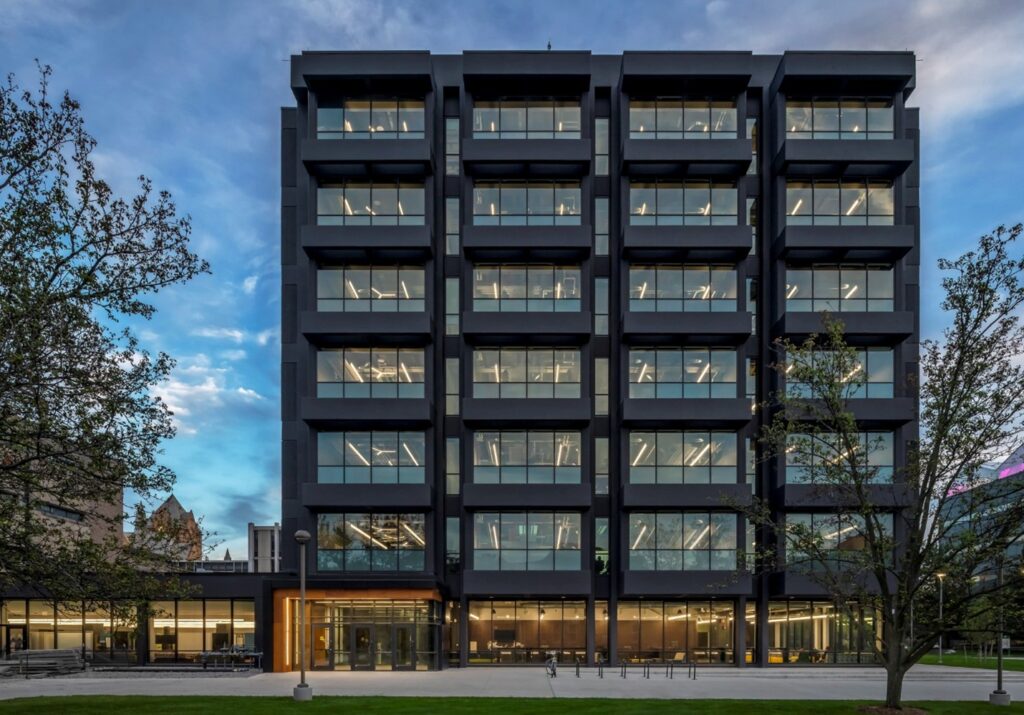
Wayne State University STEM Innovation Center
A 1960s-era engineering library transformed into a vibrant STEM Innovation Center, this project demonstrates how design can drive both carbon reduction and educational excellence. The renovation achieved LEED Gold certification, with:
- 37.5% total energy cost savings
- 91.6% of existing walls reused
- 58.5% of construction waste diverted
- Extensive use of Environmental Product Declarations (EPDs) and Health Product Declarations (HPDs)
What was once a dim, inward-facing facility is now a transparent, collaborative learning hub; proof that sustainability and user experience can grow hand in hand.

Western Michigan University Dunbar Hall
Another academic landmark, Dunbar Hall’s transformation prioritized energy efficiency, material reuse, and occupant wellness, key results include:
- 48% energy cost savings
- 33% material reuse
- 45 products with EPDs and 33 with HPDs
- 51% waste diversion from landfills
Chilled beam systems, daylighting, and high-performance glazing minimize operational impacts, while adaptive design celebrates the building’s legacy. The project earned LEED Gold certification.
Reduce, Then Offset
The path toward existing building sustainable operation begins with reducing emissions at the source. Optimize efficiency, retrofit existing systems, and electrify where it is possible to minimize impacts on the environment and operational costs. Only then should projects look to offsets, such as renewable energy generation or carbon sequestration through vegetation to close the gap toward net-zero energy and carbon.
Achieving this balance demands both technical precision and design empathy. It’s a pathway toward buildings that not only meet codes but embodies climate responsibility. LEED Operations and Maintenance (O&M) provides a framework for building owners to follow when striving for improved efficiency, educated decision making, and reduced carbon emissions.
The Future of Green Building Is Circular
LEED v5 reframes how we value buildings, not just as assets, but as carbon banks within a circular economy. By extending the life of existing structures, minimizing material impacts, and prioritizing renewable operations, we can dramatically cut emissions while preserving the stories embedded in our built heritage.
Adaptive reuse is no longer an alternative, it’s a necessity. And as the case studies show, it can deliver stunning design, high performance, and meaningful carbon reductions all at once.